Final Fantasy XV

Developed by Square Enix

Release: 2016 (Xbox One and PS4)

2917045-finalfantasy15_e32015_20150610_v1thumb.jpg
a subsidiary of Coleman products

Premise

Final Fantasy XV is an action RPG with open world elements from the long-running and recently mechanically diversified Final Fantasy series. After an abnormally long development cycle, the title was finally released onto current generation consoles with plans for minor DLC. The engines developed during the extreme production cycle are rumored to be part of future games in the series.

In FFXV, Noctis, the crown prince of a nation teetering on the brink of war, sets out with his bodyguards on a coming of age road trip to his own diplomatically necessitated marriage. However, things quickly take a dramatic turn, and what follows is a tumultuous series of events that threaten to destroy Noctis’ homeland and endanger its citizens. Thrust into the chaos unprepared, Noctis must journey to restore his country’s royal armory, rescue his bride-to-be, and defeat the evil that lurks in the shadows behind the conflict.

The Good

As with most games in the Final Fantasy series, the graphics push the limits of what is achievable with our available technology, and the score is filled with original orchestral themes. This entry is no exception in the visual department, with an absurd level of detail and quality granted to even the most minute of details. For example, Ignis, a member of Noctis’ guard, wears glasses with an identifiable in-game prescription, as the lenses are fully functional. The weird, creative designs in this installment’s world are also more or less par for the course with Final Fantasy, but the real gem is the game’s soundtrack, which incorporates hits from previous entries in the series. Though FFXV may be one of the series’ more limited soundtracks on its own, the addition of these older songs adds a hefty dose of nostalgia and makes for good traveling music.

C0uwvBxVIAAmfDE.jpg
ridiculous but impressive extra detail

The biggest shock to this reviewer, however, was the strength of the writing when it came to individual characters. Noctis, and his Crownsguard Ignis, Prompto, and Gladiolus, are given a surprising amount of depth. FFXV‘s desire to push the envelope with cutting edge visuals further manifests with each character having unique physical mannerisms that are the clear result of extensive motion capture and animation work. Even the RPG game elements help reinforce individual identities, as each character has special incomparable skills, such as Prompto’s Photography and Ignis’ Cooking, that help build up a sense of uniqueness. Though dialogue for certain repetitive actions can wear thin, for the most part each of the personalities of the characters shine through. The only caveat is that the English-voiced version dramatically alters this by repurposing dialogue to be more sarcastic and Whedon-esque, diluting the characters’ tendencies into generic pseudo-wit.

final-fantasy-15.jpg
shit just got real

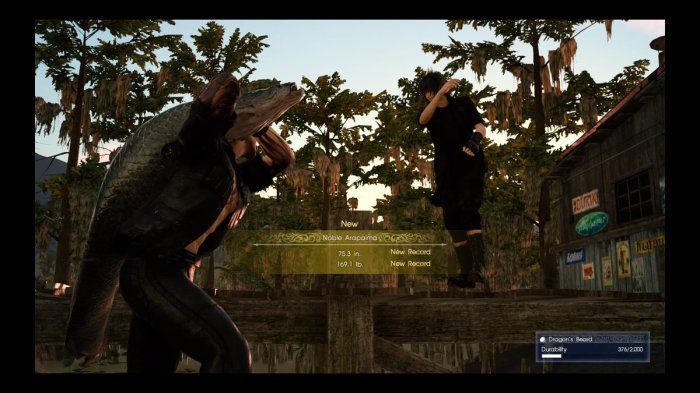
In another somewhat surprising twist, FFXV joins the small list of Final Fantasy games that utilize open world gameplay elements successfully. The overworld is a vast territory that incorporates a number of different biomes and is littered with midwest-style rest stops, motels, and diners. These stops generally serve as questing hubs with different flavors of cut-and-paste creature hunts and fetch quests, and will often contain restaurants where one can gain information about the surrounding area and eat status enhancing meals. Though the main story quest would convey a certain sense of urgency, Noctis can spend his time developing his fishing skills, exploring the wilderness aback a Chocobo, or cruising in his customizable Regalia supercar without consequence.

The Bad

FFXV is another attempt at shifting Final Fantasy towards action combat and away from its turn-based roots, this time with some real success. Combat at its core plays out as an alternation between offensive and defensive stances relying on two main buttons, and focuses less on precise timing and complicated inputs. Unfortunately, despite the simplicity in this system, fighting can frequently be unnecessarily difficult due to the nature of the game’s cluttered environments and targeting system. The camera cannot negotiate terrain and obstacles well, and targeting specific enemies in groups is a frustratingly consistent problem. Seemingly as a potential band-aid to both of these problems, a ‘wait mode’ that freezes combat while Noctis is not moving or acting was added as an optional feature, but enabling this feature defeats the purpose of an action RPG in this reviewer’s humble opinion. Additionally, the special moves that teammates can be commanded to use operate in an awkward way, often resulting in their effectiveness being greatly diminished.

Confusingly, there is a strong ‘cut-content’ vibe coming from FFXV. This feeling originates from two different components – sudden story shifts and bare-bones secondary locations. Though possibly simply due to poorly executed storytelling at times, the gaps in the story seems to hint at the presence of removed and incomplete content. This includes exposition dumps that assume knowledge of unintroduced concepts, unaccounted for absentee time, time-skips that aren’t plot justified, and interactions that, despite being part of the main story and featuring player decision-making, end up being of no consequence. Additionally, the two areas the player explores after the main zone exhibit progressively less content for no real reason. The first area visited has merely one questing hub, and the second area devolves further into a linear FFXIII-type experience. Inexplicably, the maps for these areas are detailed like that of the overworld, and several curious minds have discovered that they feature walkable terrain and strategically placed yet unused NPCs and buildings.

193731-digital_art-Final_Fantasy_XV-Altissia.jpg
I’ll take places I would’ve liked to explore more for 500, Alex

The Unique

Though clearly lacking in some areas, and somehow managing to feel like an incomplete game despite an unbelievable development period, FFXV succeeds in unexpected ways. The road trip atmosphere, the coming of age of our protagonist, and the camaraderie created from it, take hold of the spotlight and force players to experience an actual emotional connection with the characters and their plight throughout the story. If any readers have experienced gaming-inclined men and women struggling to hold back tears upon hearing this new version of “Stand By Me” that has been floating around, this is the game to blame.

In spite of its flaws, Final Fantasy XV is hard not to recommend to those sympathetic to the vices inherent in JRPGs. Though Final Fantasy remains as niche as ever, this is a good omen for the new direction of the franchise, the first since Square Enix decided to diverge from their classic formula.
C2HL6veUcAAvv_X.jpg
Final Fishing XV

Mirror’s Edge

Developed by EA DICE

Release: 2008 (PS3, Xbox 360), 2009 (PC), 2010 (iOS)

d7045b0a99e64ad068c7d86a997f36ae.jpg
Mirror’s Edgy

Premise

Mirror’s Edge is a first person action game largely focused around parkour, the art of moving quickly to get from one point to another as fast as possible. Mirror’s Edge has seen release on most major platforms, and a sequel, subtitled Catalyst, was recently released onto current generation consoles and PC.

In Mirror’s Edge, the player takes on the role of Faith, an illegal information messenger in a somewhat dystopian futuristic city. While Faith’s job as a ‘runner’ is normally to provide her clients with a clandestine way of trafficking secrets, she becomes embroiled in a plot that reveals deep corruption and a coming threat to her way of life. The player must utilize Faith’s mastery of parkour and close quarters combat to unravel the mystery and protect those she cares about.

The Good

For its time, Mirror’s Edge had a sleek, memorable presentation. Though the game world is highly detailed visually, the majority of the it is generally comprised of simple, loud colors. This is because the palette was purposely selected to highlight objects of note, so as to guide the player through more complicated scenarios. This color coordination is how Mirror’s Edge attempts to achieve flow in its gameplay, by hinting at its most effective routes of travel in each level on a moment to moment, more or less natural way. Though this feature can be disabled, and is sometimes not used particularly effectively, this is perhaps the single most clever innovation one could add to a guided game experience about parkour.

maxresdefault.jpg
bright red route highlighting for newbies

Mirror’s Edge also manages to create complexity in gameplay with simple, intuitive controls. The number of moves Faith can perform with a mere two buttons that contextually activate different actions is fairly impressive. With just two buttons and a control stick, the player can execute a series of maneuvers involving direction changes, wall-running, jumping, sliding, rolling, and spring-boarding off various objects, in most cases without relying on specifically designated locations for doing so. The game often demands perfection in executing these tasks, so, unlike other games with simple quick time events that do not feel like the player is truly performing an action, Mirror’s Edge does offer a satisfying level of challenge in that respect.

The Bad

In perhaps the most horrendous sin a full-priced game can commit, Mirror’s Edge is horrifically short. A complete playthrough of the game’s main campaign clocked in at just around three hours, and after that, the only additional play features are races, time trials, and campaign difficulty options. After experimenting with those additional modes for a short time, reaching this unavoidable conclusion was quite disappointing. Generally I don’t like to judge games based on the hour-value of the content provided, but when an offering is so paltry, it must be judged accordingly.

76ab771c3b.jpg
what completion looks like

Mirror’s Edge, though innovative in its use of parkour as a game mechanic, is still extremely broken on a fundamental level. The limited control scheme it utilizes, though brilliant in theory, is unable to compensate for the myriad of situations the player is put in. Execution failures leading to player death are easily triggered accidentally, such as wall-running when one means to climb, as the contextual ‘go higher’ and ‘go lower’ buttons only seem to look at player position, target position, and angle when determining how the player’s interaction will proceed. The player is forced to re-learn how to perform basic climbing and traversal tasks to avoid Faith deciding to take short walks off tall skyscrapers, which makes further deaths caused by these context-driven missteps to be progressively more infuriating.

Additionally, gameplay is often unintuitive or outright broken. Though the game’s system would have a player believing that they could discover their own way to tackle a problem, in the vast majority of cases options are artificially limited in a number of subtle ways. The most potent example I encountered was during a section where Faith is scaling an interior scaffolding structure, where one normal scaffolding panel is very slightly rotated to prevent the player from using it to more quickly solve the climbing puzzle. Combat is also extremely random, with sequences sometimes being completely skippable, other times requiring a series of lucky coincidences for the player to advance. The game tries to indicate which of these fights are mandatory, but on more than one occasion the red aura around enemies indicating that fights were mandatory was not telling the truth.

The Unique

The uniqueness of Mirror’s Edge is pretty self-evident. Parkour is a concept largely pushed to the background of games that feature chasing or climbing in urban environments, and basing an entire game around it is a worthy endeavor. Other than what was mentioned before, there honestly isn’t a lot to write home about. The audio and story accouterments are fairly forgettable, and the gameplay itself is incredibly fickle. However, for those who find endless joy in the rush of Mirror’s Edge‘s style of parkour in gaming, there really aren’t many good alternatives.

Mirror’s Edge is not a particularly smart, polished, or well-designed game, but the niche that it fills is sorely lacking in content. For that, if perhaps that alone, Mirror’s Edge does its premise some justice.

FTL: Faster Than Light

Developed by Subset Games

Release: 2012 (PC), 2014 (Mobile)

latest.png
FTL: Frequently Taking Losses

Premise

FTL: Faster Than Light is a top-down spaceship management simulation strategy game with roguelike elements. This dense phrase means that FTL is a game where one manages the crew and functions of a spaceship as they navigate through a series of encounters. FTL has received a major update since launch, known as the Advanced Edition, which features additional content that can be enabled or disabled at the player’s discretion. This became available to all FTL owners for free alongside the game’s mobile version release.

In FTL, the player is tasked with guiding a starship of their own choosing to the end of a series of randomly generated, but increasingly difficult, sectors of space. Once there, the player is forced into a climactic battle with a massive warship. Players have to utilize the unique benefits each starship offers, make smart choices, and acquire ship improvements to have a prayer of defeating the monstrous final warship.

The Good

FTL is a fairly deep, highly replayable experience in a fast, cheap package. Though roguelikes are generally core gamer staples, FTL is perhaps the most accessible roguelike game on the market. The harshness of this subgenre is certainly present in FTL, but the game is cleverly designed to prevent that aspect from impacting player experience too much. It accomplishes this with its emphasis on player choice, approach to creating challenge, and development of mini-goals.

FTL is choice focused on a moment to moment basis, and makes the player play some part in everything going on around them. At first this prospect can be a bit overwhelming, especially to more casual players – weapon loadout, encounter approaches, ship model and layout selection, crew station orientation, ship power prioritization, combat task management, and even enemy ship section targeting are all player responsibilities. However, despite the sheer volume of tasks, none of them are particularly complicated. The real complexity of FTL lies in planning for the future as you try to create the ideal circumstances for the completion of your mission. This hastens the learning period for first time players by a substantial margin. Over time, the player gains a better understanding of the variables at play, makes gradually more informed decisions, and maybe even defeats the boss once or twice. This increased mastery leads to faster playthroughs as well, making the game equally suited for shorter sessions and longer, multiple run sessions.

ffd7dabfef
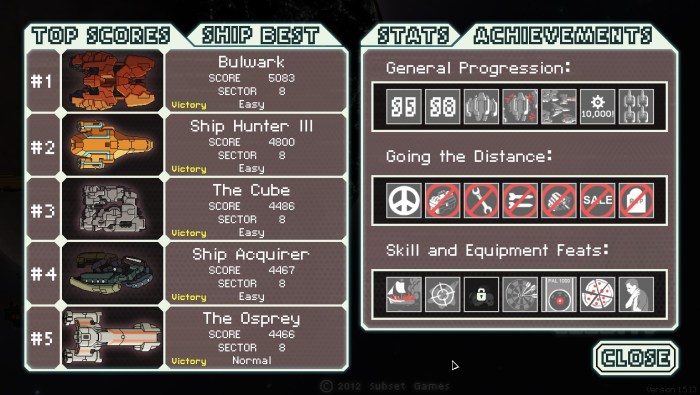
some alternate goals and a chance to show off

Creating this environment requires a lot of variety, and FTL delivers in several key ways. In addition to providing a vast assortment of game elements to play with, FTL layers the experience with alternative objectives beyond the game’s basic one. These objectives come in two mixable flavors – secret unlock and achievement-driven. Secret unlocks are generally encountered naturally in the course of gameplay, and, if certain conditions are met and appropriate choices made, reward the player with new ships and layouts. Achievements are spelled out in a special menu screen, and don’t generally provide rewards. However, many achievements push further towards experimentation, guiding the player towards the harder to unlock secret ships.

The Bad

FTL‘s weaknesses are most felt in the limitations inherent with roguelikes and some present first order optimal strategies. Compared to other roguelikes, games based on concepts like permadeath and procedural generation, FTL is toned down as far as potential negatives go due in no small part to session length. However, the best in the subgenre have more fleshed out systems that, while generally far more complex, also are less prone to abuse by the player.

Roguelikes as a whole share the problem of occasionally unavoidable “dead ending”, where the player has no recourse but to lose after a set of conditions are met. A severe variant of it would be to make a run in FTL impossible to complete given the zones the player is forced to navigate through. For example, a player ship that begins with weak defenses may be unavoidably guided to fight several ships in a row that will reasonably deal a certain amount of minimum damage, and that minimum amount may be enough to kill the player outright. Though infrequent, this also happens to a certain extent whenever the player isn’t given the opportunity to acquire tools necessary to overcome a situation they’re forced in to because of the game’s approach to procedural generation.

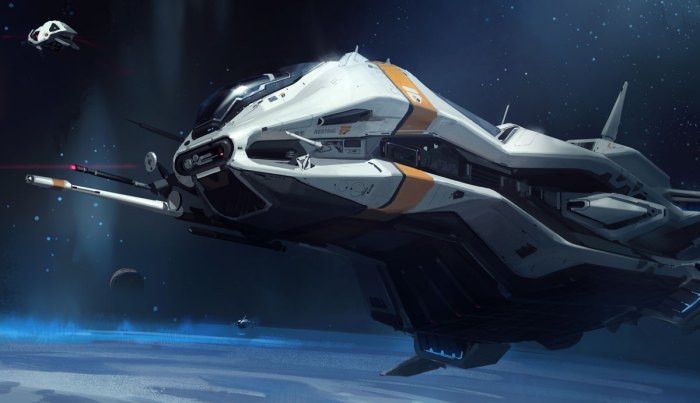
FTL‘s combat is vulnerable to some overly powerful methods of dealing with foes that lessen the impact of its attempt at creating variety in gameplay. This was fixed somewhat with the content patch, but in the base experience choosing certain ships and layouts provided dramatic benefits over others due to their initial weapon loadouts. The Kestral Type-B, for instance, begins the game with four basic lasers. These weapons are more than sufficient to handle all but the hardest content in the game, and players beginning with this loadout are free to purchase defensive upgrades and pool their resources. The Type-B quad laser battery can easily brute force down all but the strongest shields in the game, and buying just one improved laser is often enough to defeat the boss ship given a correctly handled run. Ships like the Type-B that run reliable, fast, high fire count weaponry outperform their peers at almost every level of play, and starting with weapons like that ensures an overly smooth early game that generally transitions into a late game powerhouse.

The Unique

Like with Dragon’s Dogma, the audio and visual supplements to FTL‘s gameplay are noteworthy. The simple electronic soundtrack to FTL meshes well with the graphic style, which is purposely visibly pixelated but not uncomplicated, like many lesser artists can and do produce in other games. Music also changes based on context, which is possibly the most underrated component of any game audio system. The overall presentation is sleek, smooth, and effective, which fits completely with FTL‘s quick and convenient sessions.

FTL_01jcrop2.jpg
Kestral Cruiser Type-A (source)

FTL is something worthy of utmost respect. Though gamers who enjoy more active or twitch-based games will probably not find this game as enjoyable, FTL is a smart, thoughtful quest for anyone else. For a product of this quality, completeness, and scope to have been produced despite the tiny development team behind it is nothing short of a miracle.

Dragon’s Dogma: Dark Arisen

Developed by Capcom

Release: 2012

“Dark Arisen” Version Release: 2013 (PS3, Xbox 360), 2016 (PC)

20161219221745_1.jpg
‘sup

Premise

Dragon’s Dogma: Dark Arisen is a fantasy action RPG with many traditional western RPG elements. The “Dark Arisen” version is identical in most ways to the original release of the game, then simply titled Dragon’s Dogma, but it additionally comes with bug fixes, gameplay improvements, all of the game’s DLC, and a new optional questing area that serves to lengthen the post-game adventure.

Dragon’s Dogma follows the journey of a player-created custom character trying to reclaim their stolen heart from the giant dragon Grigori, who has cursed them with a sort of vague immortality. The player grows in strength over time as they gain experience, find better gear, and master different classes, known in-game as vocations, which they can change at will to dramatically or subtly alter their play style. The player is also granted ownership over an equally customizable human-like entity known as a Pawn. The player can then create a party together with Pawns recruited from other player’s games to aid them further.

The Good

From a pure gameplay standpoint, Dragon’s Dogma doesn’t do a lot to separate itself from other games in its genre. What it does do well, however, is take existing concepts and remix them into a formula that attempts to scratch multiple itches at once. Somewhere between Dark Souls and Elder Scrolls, the middle child takes some “open world” concepts and mashes them together with an uncomplicated action combat system. Though the free exploration elements aren’t as successful, Dragon’s Dogma‘s role-playing and combat systems are definitely worth discussing.

The role-playing system strikes a good balance between giving the player the ability to craft something unique and guiding classes toward a certain playstyle. For example, one may begin as a Fighter, opting for a close range, melee-focused strategy for their character. Later, they may discover they want a change of pace and switch to a Mage or Sorcerer, which are primarily ranged, magic-focused classes. Finding neither of these to be too desirable, the player inevitably ends up settling for the Mystic Knight, a class which mixes elements of melee focused and magic focused disciplines. The way that players choose abilities and passive benefits also encourages this kind of experimentation, creating opportunities to further clarify your desired profession in the world. At the same time though, vocations still have restrictions about equipment types they can use, and weapons types can behave quite differently from each other, so classes can never deviate too far from what they’re intended to be able to do. This creates a wide template of builds to work with that are all pretty viable despite their deviations.

20161213175607_1.jpg
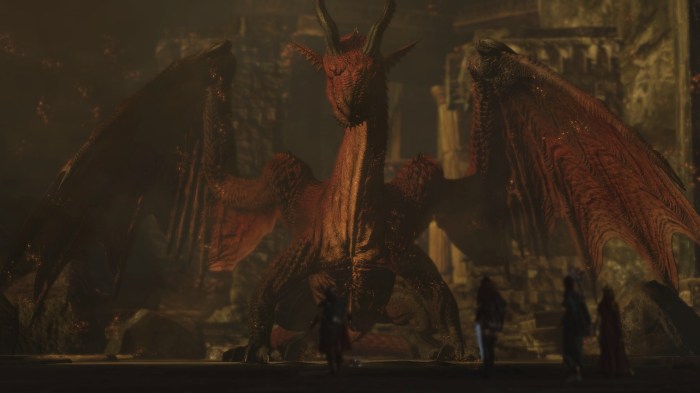
seven extra health bars on this guy

The combat is extremely easy to learn, but contains just enough flair to be satisfying and memorable. Players have a choice between different weapon types, some unique to special classes, and each weapon has a different set of light attacks, heavy attacks, upgrades, and special moves. Though punishing at times due to the lack of generalized dodging mechanics, there aren’t too many instances where you don’t understand why or how you’ve taken damage or failed to execute. Dragon’s Dogma‘s special moves and climbing mechanics are where it distinguishes itself from its peers though. Outfitting a Warrior with control and disruption special maneuvers creates an entirely different set of goals in party-building and combat than a set of moves that prioritize damage and mobility. These moves also add an extremely enjoyable element of cheese to an otherwise fairly thematically grounded world, without making things feel ridiculous. Additionally, the ability to climb on large monsters to better damage vulnerable spots is a surprisingly fun mechanic, if occasionally wonky to control. Flying through the air, sword in hand, casting absurd spells, and doing your best Shadow of the Colossus impression on towering monstrosities is pretty sweet.

The Bad

The part where Dragon’s Dogma fumbles is on the elements it borrows from Elder Scrolls style games. The open world components, while admirable to strive for, were clearly cut down quite a bit from the developer’s original intentions somewhere along the way. Though one can go anywhere one desires, it’s a bit of a farce. In Dragon’s Dogma‘s world, numerous landmarks in the game are never utilized in any way and have no quest significance or discernible lore value. Additionally, enemies are given health and damage values in such a way as to essentially prevent any and all exploration of certain areas before reaching an appropriate level.

Unlike Elder Scrolls games, where side quests often have their own unique locations associated with them or special plotlines, most side quests in Dragon’s Dogma simply retread visiting locations from story quests, which themselves were underdeveloped from a story point of view. Other quests are more or less impossible to complete without guides that show how to fulfill vague conditions or find otherwise utterly hidden items. More than once in a session the player may find themselves scratching their head, trying to figure out why it is that they’re supposed to be doing what they’re doing. This problem is compounded by generally unhelpful and oftentimes actively annoying NPCs, who show up along seemingly scripted routes approximately whenever they feel like it.

Story woes seem to be an extension of Dragon’s Dogma‘s refusal to fully explain things when called upon to. Discovering exactly how statistic growth affects one’s character class, damage, and defenses, what affinity does, what certain abilities do, and other such details are often glossed over to the point that trial and error or outside resources are the only recourse. It may sound nitpicky, but this is a particularly prevalent shortcoming in this game, even when compared to its peers, which I believe are also fairly bad at this. Truly experiencing all of the content in this game is tough, as the game itself is an insufficient teacher at times.

The Unique

Dragon’s Dogma still shines pretty brightly despite its slightly cookie-cutter nature. Despite the standard fantasy fare of topics, the original visual designs and crisp textures make these now-cliche aspects feel fresh again. Also in service of the game’s thematic premise is a phenomenal nearly five hour long original soundtrack. This godly soundtrack features a wide variety of themes and a staggering number of variants on those themes for just about every enemy type and encounter. If this level of care had been taken with every aspect of the game, this game would be a well-known IP with several installments by now.

20161221223841_1.jpg
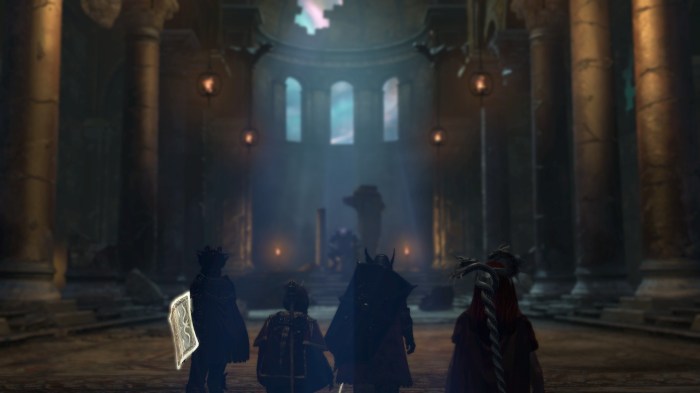
bosses love ruined cathedrals

While Dragon’s Dogma is certainly not a game for everyone, I would highly recommend it to fans of action roleplaying games. Enjoying this game’s combat system and aesthetic choices makes it much easier to forgive its other shortcomings. It’s just a shame that the game never fully coalesced.

New Year, New Direction

It’s time for something new. I enjoy doing game analyses, but they tend to take too long and are hard to make concise. The problem that creates is that I don’t end up writing that frequently or producing that much, which is good at killing my motivation. So, starting this week, I’m going to do one entry in a video game review series per week. I’m still going to do an analysis or rant approximately whenever I feel like it, and I’m still not quite settled on the format for the reviews, but I want to end up producing one solid, short to medium length review of a game per week. Whereas analyses should produce super in-depth, highly focused pieces that are fairly long and detailed, my reviews are instead going to try to quickly cover as much of the product as possible to create a sense of understanding for an audience that hasn’t necessarily played the game.

So we’ll see how this goes, but even if I change the format along the way I plan on doing one per week every week. Since I cannot keep up with playing a new game each week, probably about half the time the review will be for an older game that I haven’t talked about yet elsewhere.