Developed by Subset Games
Release: 2012 (PC), 2014 (Mobile)

Premise
FTL: Faster Than Light is a top-down spaceship management simulation strategy game with roguelike elements. This dense phrase means that FTL is a game where one manages the crew and functions of a spaceship as they navigate through a series of encounters. FTL has received a major update since launch, known as the Advanced Edition, which features additional content that can be enabled or disabled at the player’s discretion. This became available to all FTL owners for free alongside the game’s mobile version release.
In FTL, the player is tasked with guiding a starship of their own choosing to the end of a series of randomly generated, but increasingly difficult, sectors of space. Once there, the player is forced into a climactic battle with a massive warship. Players have to utilize the unique benefits each starship offers, make smart choices, and acquire ship improvements to have a prayer of defeating the monstrous final warship.
The Good
FTL is a fairly deep, highly replayable experience in a fast, cheap package. Though roguelikes are generally core gamer staples, FTL is perhaps the most accessible roguelike game on the market. The harshness of this subgenre is certainly present in FTL, but the game is cleverly designed to prevent that aspect from impacting player experience too much. It accomplishes this with its emphasis on player choice, approach to creating challenge, and development of mini-goals.
FTL is choice focused on a moment to moment basis, and makes the player play some part in everything going on around them. At first this prospect can be a bit overwhelming, especially to more casual players – weapon loadout, encounter approaches, ship model and layout selection, crew station orientation, ship power prioritization, combat task management, and even enemy ship section targeting are all player responsibilities. However, despite the sheer volume of tasks, none of them are particularly complicated. The real complexity of FTL lies in planning for the future as you try to create the ideal circumstances for the completion of your mission. This hastens the learning period for first time players by a substantial margin. Over time, the player gains a better understanding of the variables at play, makes gradually more informed decisions, and maybe even defeats the boss once or twice. This increased mastery leads to faster playthroughs as well, making the game equally suited for shorter sessions and longer, multiple run sessions.
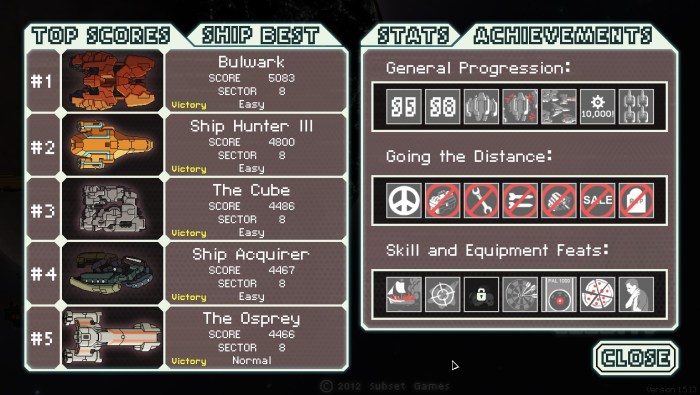
Creating this environment requires a lot of variety, and FTL delivers in several key ways. In addition to providing a vast assortment of game elements to play with, FTL layers the experience with alternative objectives beyond the game’s basic one. These objectives come in two mixable flavors – secret unlock and achievement-driven. Secret unlocks are generally encountered naturally in the course of gameplay, and, if certain conditions are met and appropriate choices made, reward the player with new ships and layouts. Achievements are spelled out in a special menu screen, and don’t generally provide rewards. However, many achievements push further towards experimentation, guiding the player towards the harder to unlock secret ships.
The Bad
FTL‘s weaknesses are most felt in the limitations inherent with roguelikes and some present first order optimal strategies. Compared to other roguelikes, games based on concepts like permadeath and procedural generation, FTL is toned down as far as potential negatives go due in no small part to session length. However, the best in the subgenre have more fleshed out systems that, while generally far more complex, also are less prone to abuse by the player.
Roguelikes as a whole share the problem of occasionally unavoidable “dead ending”, where the player has no recourse but to lose after a set of conditions are met. A severe variant of it would be to make a run in FTL impossible to complete given the zones the player is forced to navigate through. For example, a player ship that begins with weak defenses may be unavoidably guided to fight several ships in a row that will reasonably deal a certain amount of minimum damage, and that minimum amount may be enough to kill the player outright. Though infrequent, this also happens to a certain extent whenever the player isn’t given the opportunity to acquire tools necessary to overcome a situation they’re forced in to because of the game’s approach to procedural generation.
FTL‘s combat is vulnerable to some overly powerful methods of dealing with foes that lessen the impact of its attempt at creating variety in gameplay. This was fixed somewhat with the content patch, but in the base experience choosing certain ships and layouts provided dramatic benefits over others due to their initial weapon loadouts. The Kestral Type-B, for instance, begins the game with four basic lasers. These weapons are more than sufficient to handle all but the hardest content in the game, and players beginning with this loadout are free to purchase defensive upgrades and pool their resources. The Type-B quad laser battery can easily brute force down all but the strongest shields in the game, and buying just one improved laser is often enough to defeat the boss ship given a correctly handled run. Ships like the Type-B that run reliable, fast, high fire count weaponry outperform their peers at almost every level of play, and starting with weapons like that ensures an overly smooth early game that generally transitions into a late game powerhouse.
The Unique
Like with Dragon’s Dogma, the audio and visual supplements to FTL‘s gameplay are noteworthy. The simple electronic soundtrack to FTL meshes well with the graphic style, which is purposely visibly pixelated but not uncomplicated, like many lesser artists can and do produce in other games. Music also changes based on context, which is possibly the most underrated component of any game audio system. The overall presentation is sleek, smooth, and effective, which fits completely with FTL‘s quick and convenient sessions.
FTL is something worthy of utmost respect. Though gamers who enjoy more active or twitch-based games will probably not find this game as enjoyable, FTL is a smart, thoughtful quest for anyone else. For a product of this quality, completeness, and scope to have been produced despite the tiny development team behind it is nothing short of a miracle.
 The Back Burner