Developed by Kojima Productions
Release: 2015 (PC, PS3, PS4, Xbox 360, and Xbox One)
Premise
Metal Gear Solid V: The Phantom Pain (hereafter referred to as MGSV) is the latest, and supposedly last, main story entry in Hideo Kojima’s venerable Metal Gear franchise. MGSV is an action game with a heavy emphasis on stealth, along with some open world components. It was released soon after Ground Zeroes, a dramatically shorter game that functioned as a demo for the engine used in MGSV, and prior to the full online mode known as Metal Gear Solid V Online.
MGSV continues the story of Big Boss, the decorated war hero turned mercenary. After falling into a coma following the destruction of his paramilitary organization, Big Boss awakens nearly a decade later in the mid 1980s. Big Boss quickly establishes a new unit, which he dubs the “Diamond Dogs”, and sets out to the world’s least stable regions in search of the men who wronged him. However, the dangerous war zones of the time hide secrets that force Big Boss to adopt a different goal.
The Good
MGSV offers something that was partially promised in the last installment but wasn’t really delivered on: player freedom. Big Boss may only have a set number of slots for utility technologies, weapons, and armor, but the detail in his armory is extremely impressive. For example, when selecting from the massive array of potential weapons, players can tinker with nearly every aspect of their firearm, right down to the length of its barrel. This trend holds for most of the game’s related systems, most importantly its story missions. Though there are certain scripted scenarios, sub-objectives, and primary objectives that do not change, how the player chooses to go about completing them is entirely of their own design. The toolkit MGSV offers players and the sandbox it allows them to play in are both more than a step beyond the ordinary.
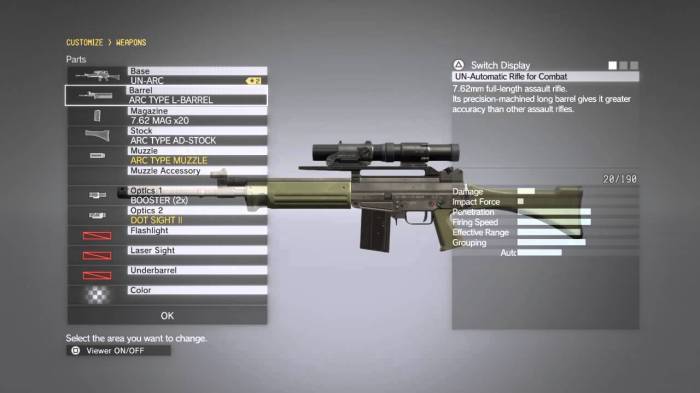
Tied in with this new level of customization are the resources required to earn it. The Diamond Dogs’ (or whatever you decide to name them) base of operations, Mother Base, can’t produce the tech you want effortlessly – you have to staff and develop it. Here MGSV borrows from several other Metal Gear Solid games with the staff acquisition mechanic, which allows the player to extract unconscious soldiers from the field and forcibly recruit them. Managing your roster and scouting for the best and brightest during missions and while free-roaming adds another constant but unintrusive sidequest that helps the research and upgrade system feel more natural. A lot of the appeal of completing alternative objectives and optional missions are special troopers with rare skills or the ability to access new technologies. This is a good way to reward players for exploration and completionist tendencies while also not necessitating exhaustive play.
MGSV also breaks with conventional series controls, and the change meshes really well with the previously discussed new mechanics. The new control paradigm feels more like an action game than a pure stealth game, emphasizing aggressive actions such as diving and reflex shots. This allows the player to transition from covert to overt and vice versa on a dime, and doing so is imperative for all but the most flawless of operatives. When things begin to go wrong, a player can react in a number of ways to either maintain or forgo stealth, both of which have their comparative advantages. Though MGSV’s predecessors punish the latter option, the robust nature of the systems now in place naturally make any solution one could come up with using the tools in the armory viable. The game will still punish lack of subtlety in the mission scoring system, but acquiring good mission ratings does not hinge on perfect stealth.
The Bad
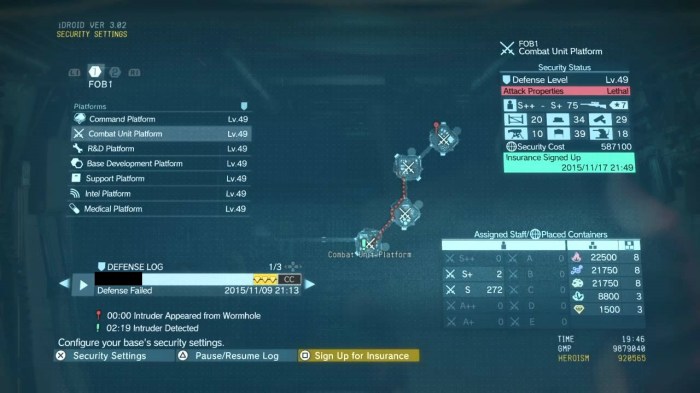
Several systems are debilitated by concepts stolen from mobile game theory, that quagmire of snake oil. Many mobile games use psychological traps and delayed gratification to goad players into buying virtual currency and shortcuts, neither of which they need. MGSV does this by delaying technology development times, then offering players paid ways to expedite these times. Though this reviewer will steer clear of bashing game developers or producers, the drama surrounding MGSV, its creator Hideo Kojima, and the publisher Konami is well-known. Konami’s recent practices would suggest this feature was an attempt to profit more off MGSV‘s potential success, but the origin doesn’t excuse the impact on the game. Finding resources in a primarily single player game, only to have them be unusable, agonizingly held in reserve, and slowly disbursed at real-time intervals is shameful and frustrating. Though somewhat interesting, the base invasion asymmetric multiplayer also has a very strong ‘tacked on’ vibe. Mobile games often throw together some mode that gets players to compete against one another, then offer advantages for premiums. MGSV does this as well, allowing users to pay for stronger base defenses and insurance on their steal-able resources.
This Metal Gear Solid focuses a lot more heavily on gameplay than story, which is a fine thing to do. That isn’t to say that MGSV is devoid of a plot, but it is fair to say that this installment seems tame by comparison to other absurd and memorable quirks of the past. There are still classic moments and some memeworthy dialogue on occasion, but there is a sharp and indefensible drop in quality after the first chapter. This wouldn’t be particularly noteworthy on its own, but the lackluster story also ends up translating into lackluster mission design at this juncture. The majority of the missions near the end of the game’s content are simply rehashes of older missions with restrictions. Though performing under special circumstances is often a fun challenge, these should have been relegated to side missions and replaced with real story-progessing content. This would probably be greatly preferable to the current iteration of Ubisoft-style cut-and-paste side missions in the minds of most players.
The Unique
The strength of MGSV is in how it fuses its tried and true tactical espionage action to an open-world experience. The Metal Gear series has always brought stellar visuals and great original soundtracks with their corny drama and twisting storylines, but this installment drops the strength of story somewhat in favor of heightened strength in gameplay. Some people may have a problem with that, but with the way things are changing in the AAA development scene, this reviewer considers that to be a breath of fresh air. MGSV delivers a sublime fusion of modern concepts that can provide a staggering amount of entertainment value.

Now if we could just get David Hayter back to perfect the voice work we’d really be set.
 The Back Burner