Developed by Atlus
Released: 2016 (PS3, PS4 – Japan Only), 2017 (PS3, PS4 – Everywhere Else)

Premise
Persona 5 is the newest game in the Shin Megami Tensei spin off series, and the first to officially drop the mainline series’ name from its title. Like previous entries, Persona 5 blends together turn-based RPG combat and dungeon crawling with time management and visual novel gameplay aspects. Though it originally debuted in late 2016 in the Japan region only, it was released worldwide several months after.
Persona 5 yet again has the player assuming the role of a Japanese high school student, this time one who is accused of a crime he did not commit. Expelled from school and put on probation, the canonically named protagonist Akira Kurusu is forced to move to Tokyo, live with a temporary guardian, and attend the nearby Shujin Academy for his schooling. However, it’s not long before his rehabilitation is derailed, and a new, much stranger journey begins.
Gameplay
By now, the Persona formula has become somewhat familiar to gamers. Part dungeon crawler and part visual novel, players must balance different aspects of a high school student’s life against an impending threat that will spell doom for them should it be left unchecked. On the surface, not much has changed apart from the cast and setting. Each individual component of the Persona formula, however, has been upgraded and refined to add depth or improve quality of life for the player. For example, while Persona 4 required players to manually check or memorize locations and schedules for socializing, Persona 5 tracks characters by location and indicates their availability clearly, cutting the fat of wandering around previously explored areas ad nauseum from the gameplay loop. Similarly clever tweaks have been made to a number of systems, including combat, which has received an overhaul that increases players’ tactical options significantly. Though too numerous to list in their entirety, these additions better the player experience when compared to previous Persona games to the point where replaying older installments may become challenging.

Persona games of late have each carried with them a different theme that is reflected in numerous aspects of gameplay and visuals, but none is as strong as how Persona 5‘s Phantom Thief motif influences its improved dungeon crawling. Dungeons are now a series of varied locations with traditionally high security, and they must be burgled of their most valuable possession. Story dungeons, excluding an optional dungeon that admittedly is quite repetitive, are now highly designed experiences that feature labyrinthine structure, real-world event gating, a guard alertness system, traps, and rest stops that act as checkpoints and shortcuts. Each dungeon also has a few unique components that differentiate it from its predecessors beyond its radically different appearance. The goal is still to reach the end and defeat the boss, but even the simple act of engaging the boss has received a stylish pass of Phantom Thief inspiration. The difference between ‘reach the end and defeat the boss’ and ‘carefully map out an entry route to steal the treasure from the boss’ is how much more satisfying these new ‘heists’ feel in comparison.
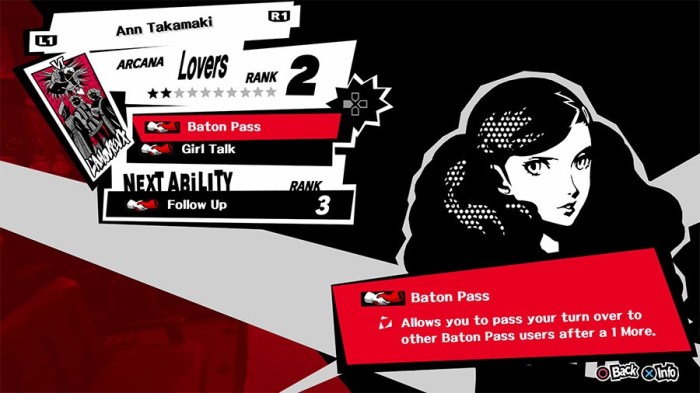
A smaller aspect of Persona 5‘s new design that has been sorely overlooked is the alteration to the social link system. Confidants, or, as they were referred to in previous games, Social Links, are relationships that you develop with various characters in the game. This is the visual novel aspect of Persona games: spending time with these characters and making conversation choices to deepen your relationships. This, in turn, improves the protagonist’s creation abilities with the arcana of Persona that character represents. Though often important for fusing and creating optimum combat strategies, the social link system’s connection to other gameplay elements has always been rather weak. Confidants, be they party members or random people met on the street, now all have their own special side quests and unlockable abilities that can grant the Phantom Thieves a variety of bonus effects. These can run the gamut from combat skills and tactics to special time management techniques and equipment unlocks, and almost always have a significant impact on gameplay at their later ranks. This tightens the motivation to explore each and every character relationship to its fullest, even if it might be difficult to do so.
Presentation
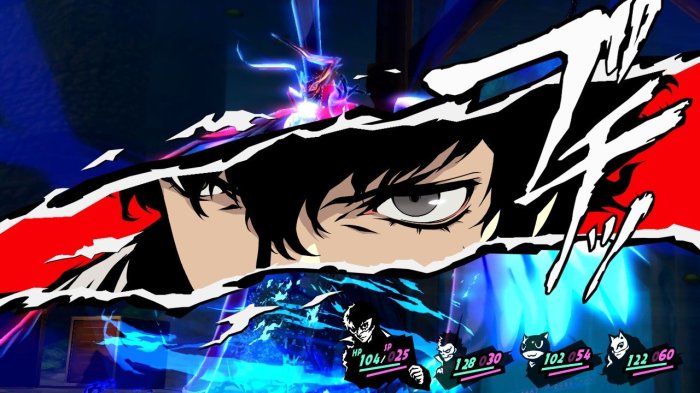
It’s no secret that the Persona series oozes style, but Persona 5 fully commits to creating a singular set of visual aesthetics. Though hard to simply describe, Persona 5 adds a kind of aggressive comic styling to all of its menus and user interface, all based on a color scheme of primarily shades of white, red, and black. While the previous two installments of Persona entries kept their user interfaces largely minimalist and based on a single color, Persona 5’s is a noticeable departure. In addition to interface styling, more detail and expressiveness is apparent in Persona‘s particular brand of manga-esque character models and now highly-popularized version of visual onomatopoeia. The visual design, combined with the expectedly catchy, memorable, and occasionally silly Shoji Meguro original soundtrack (the most memorable of which can be found here), creates an unforgettable atmosphere.
Legacy
At this point, it seems clear where this review would find Persona 5 in its lineage – as the natural evolution and most complete version of itself. Though there are ways to argue that components of previous incarnations could be considered comparable or superior, perhaps in character writing or story direction, as an overall package it’s hard to make that claim. Normally this would be a section to do comparison within the genre and its own franchise, but it’s more interesting to consider what Persona has become nowadays – mainstream. A JRPG competing in sales with the likes of Mario Kart in western countries is pretty damn impressive, but what’s more impressive is that it manages to do it on a system involving visual novel gameplay and turn-based combat. With its unique approaches to even the most tired and niche gameplay elements, Persona proves that, with enough passion and creativity, anything can transcend its stereotypes.

 The Back Burner