Developed by From Software
Release: 2011 (Console), 2012 (PC)

Prepare To Die (and like it)
As a gamer, I have lost many hours to Dark Souls. I picked it up out of nowhere at its release with no expectations, having never played Demon’s Souls, the game it succeeded in a spiritual sense. Plain and simple, it’s a modern masterpiece. I love this game. My bias is now established.
Featuring an expansive, well-defined world nearly devoid of loading screens, tight and responsive combat, and famously skill-based (read challenging) progression, Dark Souls reinvigorated interest in action RPGs and simultaneously carved out its own identity in a way few games have. Dark Souls is a fantastic example of great game design, but it is by no means a perfect game.
Praise That Sun
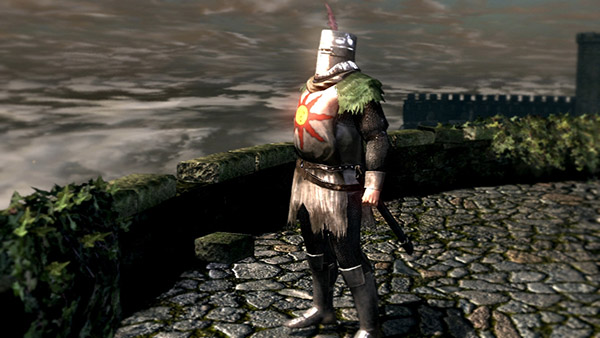
Dark Souls‘ strongest component is the one that everyone mentions – the difficulty. Every damn thing in the game, other than maybe equipping weapons, is tough. There are no minimaps or guides – you must learn the lay of the land through experience and NPC guidance. There is no combat tutorial – you must figure out how to treat each opponent and weapon with elbow grease and through death. Even discovering who you are, how you fit into the game world, and what you’re supposed to do isn’t straightforward. You must use information from items, tips from in-game characters, and intuition to find your way in Lordran. Prepare to freaking die.
The difficulty, unlike some games in the genre, doesn’t revolve around lazy design solutions like massive enemy health pools or punishing timing challenges. The scale is simply set closer to ‘realistic’. When I say this, I don’t mean to imply that Dark Souls captures the essence of true exploration or combat perfectly, rather that it strives to incorporate real-life restrictions into certain components of the game. The resulting system involves lots of room for growth and mastery. Dark Souls gives you controls and some basic premises and asks you to explore, learn, and grow powerful on your own, rather than clunkily dragging you between set pieces and overtly comparing your ‘levels’ with regions and enemies.
During this fledgling period of learning, the player dies. In fact, they die a lot. It is at this time that the player comes into their own style of play. In between numerous deaths, players find weapons and armor that suit them and develop combat strategies on the simpler enemies that they will have to apply on more complicated foes later. The early sections of the game players find themselves in teach them the basic lessons of survival, such as when and how to fight, where to find respite, and how to approach the game world. Conquering those first few zones and bosses forges the player into a true adventurer, ready to test their newly developed skills against Dark Souls‘ myriad of other challenges.
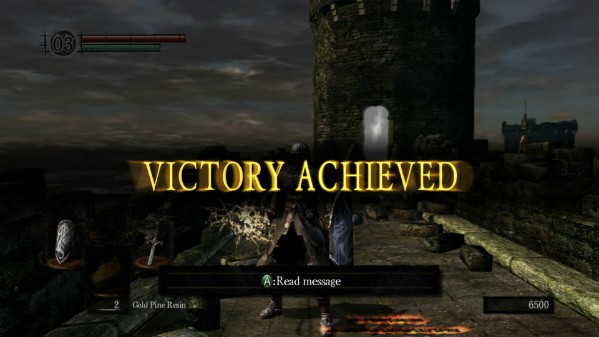
Reaching this point is surprisingly rewarding. As a player, you become invested in your developed techniques and weapon preferences. Unlike many other action games and RPGs that guide you into a predetermined role, or that present you with a large number of largely meaningless choices, Dark Souls tasks you with forging your own role. This amplifies the meaning of everything you do after this point. It isn’t some character conquering the Taurus Demon, you are conquering the great beast. Your ingenuity, prowess, and choices, forged in determination and tempered by death after death, are the weapons Dark Souls arms you with. That is the goal of Dark Souls‘ fabled difficulty: creating a personal relationship between the player and their play. I can’t think of a better example of succeeding in this respect.
Where The Sun Don’t Shine
Let me clarify before we move on – this is not going to be a discussion of the places that Dark Souls was weakest in execution, but rather in design. For example, from a high design perspective, the flighty summoning system was pretty cool, even if the connectivity was buggy and poorly implemented.
Some of the weaker aspects of Dark Souls are fairly obvious and easily reconcilable. On the RPG side, character parameters are probably too obtuse. Many statistics have hidden soft and hard caps at various levels, and one statistic, Resistance, is largely regarded as completely useless. Ideally, every statistic should have a point, and players shouldn’t be unsure as to whether a stat they are investing in is actually going to return solid benefit. For example, a person investing a point in Attunement in hopes of attaining another spell slot after rank 50 will never reap any benefit. Ranks 50-99 for Attunement, 99 being the maximum rank a character can level a characteristic, simply do nothing. The game does allow you to preview how your parameters will change your character’s derivative stats, but this can be misleading as well, as some levels of parameter points will contribute more or less to a skill. All of this can be fixed by giving the player more foresight on how they will evolve given more point investment. Transparency solves all but the problem with Resistance, which was fixed in the next iteration of Dark Souls by breaking the stat apart into a different one.
The most daunting problem in Dark Souls is pretty apparent to anyone who has played the game though. Of course, I am referring to none other than…

The Bed of Chaos (and The Infinite Sadness)
I would be remiss neglecting to mention the terrible Bed of Chaos boss as an easily fixed example of weak design. As a mid to late game boss, the out-of-nowhere badness of the Bed of Chaos is jarring, and one of Dark Souls‘ biggest flaws. To give those with no experience with the game a feel for the Bed of Chaos, I will discuss the general strategy one needs to defeat it, then explain why this necessary strategy is an example of bad design.
In the boss fight, the player is dropped into a circular room near an edge. The player sees a great tree at the opposite side that encompasses the other hemisphere of the room, and a menacing cinematic informs them that it is the boss. From here the fight begins immediately. The general strategy for the boss involves jumping while avoiding the boss’ swiping attacks, working to the upper right and upper left sides of the room in either order. At these locations, the player must destroy an important-looking root. Unfortunately, the floor is crumbling, forming makeshift platforms the player must utilize, and making the Bed of Chaos’ swiping attacks even more deadly, as falling into the opened holes leads to death. After both roots are destroyed, the player can jump into the center of the tree to slay an evil bug-thing that hides in the center.
So, why is this a terrible fight? There is a strong plot premise to make this fight necessary, and, by itself, the fight doesn’t sound so arduous. Unfortunately, this fight is incredibly out of place stylistically, making it a uniquely bad addition to Dark Souls.
Misinformation is the cardinal sin here. When a boss fight begins in general, a name for the boss and a health bar appears at the bottom of the screen. When you deal damage to the boss, the health bar depletes, and when the health bar hits zero, the boss is defeated. Every boss prior to this one, and every boss after this one, works with the same health bar mechanic. This boss fight claims to feature the same mechanic, but functionally ignores it. Upon destroying the first of the two obvious weak points, the player is rewarded with a cinematic wherein the boss grows more dangerous. After the cinematic, the player will notice that the boss health bar has not changed. Based on feedback and appearances, the player has only made the boss more difficult to fight, as the new fiery arm-growth adds a scything fire slash to the Bed of Chaos’ set of attacks. This combined with the crumbling floor and basic swipe attack makes the approach to the second root much more difficult. At this point the player begins to wonder about the value of destroying the second root. Why should the player continue to attack the boss in such a way, when doing so has made the boss more powerful and offered no discernible advantage? This interaction triggers questions in the player that lead them to explore alternatives to destroying the second root, of which there are none.

The binary nature of the fight is another major problem. Most Dark Souls boss fights have several methods of approach that different playstyles can utilize. There are almost always direct methods of attack, ranged methods of attack, and boss patterns to exploit in numerous ways. The Bed of Chaos offers no such room for meaningful combat. You must destroy the two roots and head into the center with no exceptions. Your playstyle and developed character role, be you a bulky tank, speedy melee, heavy weapons wielder, mage, cleric, whatever, is reduced to running and jumping. Many classes at this point would normally not require exceptional stamina or extraordinarily low equipment weights, both of which govern your running and jumping abilities. If your character lacks those aspects at this point, this fight becomes exponentially more difficult. There is very little room for adjustment and tactical decisions based on boss-player interaction in this fight as well, as every mistake leads to instant death, and characteristic determining decisions are irreversible and progressively more difficult to attain. Instead of adapting your character and build to the situation, the situation necessitates a certain style of character.
Put It To Bed
Normally I would make suggestions on how to improve the component I’ve analyzed here, but in this case all I can think of is complete rework. The fundamental principle of this fight, pressured platforming, is completely out of place in Dark Souls. Though many minor changes could be made to the fight to make it more responsive to the player, like making the health bar drop a bit after killing each root, or cleaning up the room’s platform layout to make it less of a trial-and-error challenge, the fight is a conceptually poor addition to the universe.
As far as a rework goes, incorporating the most sensible part of the previous version of the fight, the destruction of the tree’s roots, is pretty easy to do. My first thought would be to have the room set up similarly to the original room, as a circular arena. Compared to the previous version, the room size would be increased by roughly 1.5 times, and the boss would be placed at the center. Roots would be scattered throughout the room, and there would be more of them for the player to destroy. Increasing the number and obviousness of the roots increases the likelihood that a player will grasp the concept for defeating the boss. Instead of a set pattern of room crumbling, the outskirts of the room, once walled off, are now bottomless pits in all directions. Being knocked out of the arena by a sweeping attack means death. In addition, portions of the room falling apart is triggered by root destruction instead of a player being right next to them, and the destroyed parts are localized around the root and slightly delayed, giving a clearer sense of cause and effect than before. A boss powerup component like in the current version would be unnecessary, as your options would decrease each time you destroyed a root. The end goal is to work your way around the room destroying roots, either carefully as a melee character, or by sniping and dodging as a ranged character, then make your way into the middle of the tree to destroy the bug creature from the previous version. No unpredictable floor drops, no repeated platform failing, no required repeated attempts, and an actually mutable boss approach. Less frustration, more actual boss fighting. That’s a wrap.
Final Thoughts
For these first few Analyses there won’t be a whole lot to say here that you haven’t already heard in the intro. As all of the games I’ll be looking at in depth are some of my favorites of all time, it’s hard to do more than gush at the picture as a whole. I think that looking at one’s own favorite games for high and low points conceptually is important though. Being able to work past your own giddiness at how much you love the product and analyze it in-depth is crucial for the iterative process. Even Dark Souls, one of the most powerful games I have played, has its share of weaknesses.
Let me know what you all think in the comments. Should I do TL;DRs? Did I miss anything? Any defenders of the Bed of Chaos fight out there? All feedback is welcome!
 The Back Burner