Developed by Namco Tales Studio
Release: 2003

Tales of My Childhood
One day in Blockbuster, nestled between SSX Tricky and Wave Race, I found Tales of Symphonia. The cover (seen above) featured swords, drama, and crisp Japanese visual styling. There was only one copy left, maybe only one copy in that store’s circulation, and I hurriedly grabbed it. It wouldn’t return to this shelf again.
Featuring a cheesy yet memorable cast of characters, uncomplicated inventory and skills management systems, and dynamic, addictive combat, Tales of Symphonia is the quintessential JRPG, the standard to which I now hold all others. It was my first taste of games with roleplaying depth, but how much of my love is actually just nostalgia? Let’s find out.
Harmonic Symphonia
The first thing that blew me away about Tales of Symphonia was the scope of the game. Prior to playing this game, I had no experience with games with hundreds of hours of content. Unbeknownst to my preteen self, Symphonia was not just a standalone experience, but the next installment in a series of JRPG games created by the Namco Tales Studio, each of which was titled similarly. However, Symphonia was the first major international Tales title, and was moving the series onto a new console, the Nintendo Gamecube. There was a lot riding on the success of the game, and you can feel the effort the developers put into it in the tidal wave of decorative features accompanying the core systems returning from previous games.
Tales games always revolve around a party of characters. For plot reasons, the characters come together to venture out on an epic quest filled with danger, intrigue, and a healthy dose of anime cliche. Each character has a unique weapon and armor preference, set of skills, combat statistic growth patterns, and titles (more on that later). This is where the meat of the game is – combat and character development. There are other major components to the Symphonia package such as dungeon crawling, relationship development, and the story, but the character development and combat systems are the strongest points. The way the two are mixed is notably novel for its time.
Growing Tales
Symphonia’s character development is done in a rather interesting way. Titles, which can be earned for performing special achievements, reaching certain plot points, or completing sidequests, augment the growth of your character’s statistics. The more impressive the achievement or exciting the plot development, the more potent the title’s offsets. Each character’s active title can be swapped out with another from their collection of unlocked titles to change the way their statistics develop at any time. In addition to titles, statistics can be modified by equipment acquired from various sources throughout the game. This allows you to gradually shift and hone your character’s focus overall, while simultaneously making instantaneous adjustments through equipment swaps to get to exactly where you want to be.
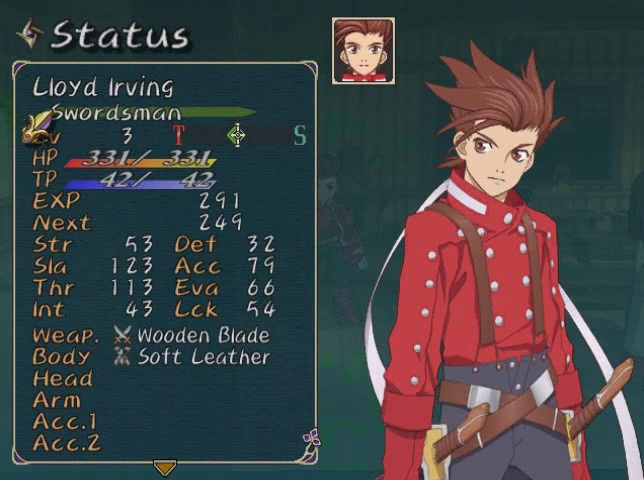
The other major development system is the tracking of Strike versus Technical levels of each character. These two abstract concepts are meant to represent the tendencies of your special moves, specifically whether they are more direct and physical, or tricky and finessed. Throughout the game, characters naturally develop an ability pool based on their overall experience in combat. However, the element of moves you tend to favor causes your moveset will evolve accordingly. For example, for the main character, who wields two swords and deals mostly direct physical hits, favoring Strike unlocks big single hit move variants and linebacker-like charges, whereas favoring Technical unlocks multiple hit moves and acrobatic skills. Being able to guide your character’s growth while the game simultaneously causes your character to grow with your own playstyle is extremely satisfying and ambitious, even in this relatively simple execution. Without these systems in place, Symphonia‘s combat probably wouldn’t feel as rewarding.
2D Combat Goes 3D
Speaking of combat, Symphonia‘s combat is actually somewhat difficult to describe, so I’ll cheat a little bit.
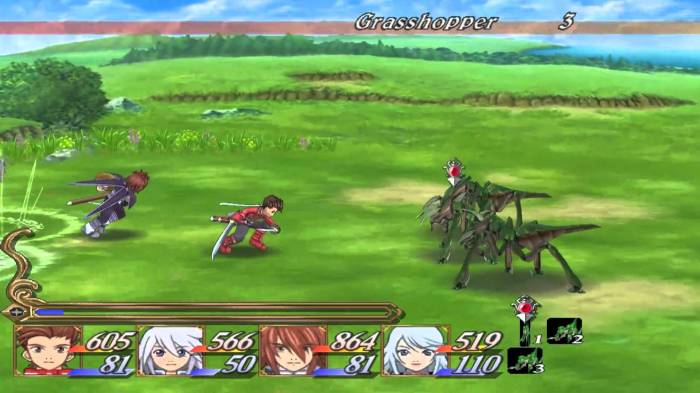
Let’s take this apart piece by piece. There’s some combat information at the top and bottom, and the center of the screen is occupied by the combatants. The player controls only one character at a time in their party of characters, but more players can drop in and out or switch who they control on the fly. Though appearing fully 3D, the player controlled character is secretly lined up on an invisible 2D path with his target, and can move left and right on that plane only. The player can adjust their target, changing how they are oriented and who their attacks are directed against. This somewhat awkward marriage of 2D and 3D is part of the Tales series’ transition into uncharted territory, as previous games were fought in a solely 2D plane.
Each character has a different set of basic physical attacks that restore technical points, and a customizable range of special attacks that consume them. Special moves have to be mapped, so you only have access to a subset of your potential moves. You can also block attacks and perform backsteps and such. It’s a little weird the way it’s set up, but it all flows beautifully. You tend to favor a certain set of your character’s moves, so you usually map those. Your character learns skills based on what skills he or she uses, so you develop more powerful moves based on other moves you already know you like. Some skills can be linked into others, and you form combos naturally by combining progressively more complicated or explosive moves that you earn by using your lesser moves. Though at this point I may have impressed upon you how interesting the combat mechanics are under the hood, there’s something more that makes it fun on a moment-to-moment basis.
The Flow of the Fight
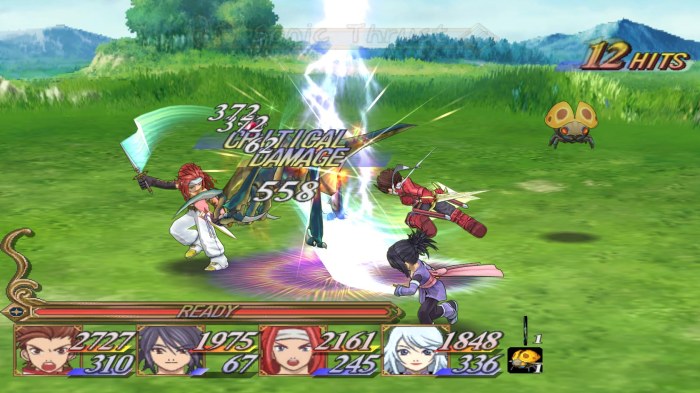
There’s one more system present in Symphonia that isn’t ever properly explained to the player, and it’s the pivotal aspect of that moment-to-moment fun I was talking about. Symphonia has an unspoken ‘stunning’ mechanic that requires a little explanation, but it’s a big part of why combat feels so satisfying. The mechanic is introduced to you slowly and indirectly, but the game manages to teach you exactly how it works without any detailed explanations or clunky tutorials. The best games always do this with some or all of their mechanics (Dark Souls). This is how you are taught the ways of the combo.
From the moment you are first introduced to combat, you’ll notice that enemies that receive damage from your attacks tend to flinch for awhile, interrupting their current actions and animations. This makes dispatching the earliest enemies a simple task, as you can focus a helpless weakling down with impunity. A short time later, you’ll meet enemies that can guard, or that don’t flinch when you use your basic attacks. While enemies are guarding, they have a noticeable visual cue, will not increment the combo hit counter when damaged, take reduced damage overall, don’t become stunned, and can even counterattack faster than normal if you attack them repeatedly. The strategy becomes clear – wait until they stop guarding, or push through and break their guard with a strong enough move, then get them stunned in your attacks like normal. Things change even more when you meet your first boss.

This boss, like most subsequently encountered large creatures, does not flinch when receiving attacks, generally receives reduced damage, and hitting him does not increase the hit counter. He’s slow and lumbering, and you can only really attack him during his idle periods immediately before and after attacks. However, after a number of successful flurries, the enemy’s indifferent nature changes. Suddenly, an attack you launch creates a shattering glass sound effect with an appropriate associated visual. The hit counter goes up like it did before, tracking the number of successive blows you land on the boss. The boss’ inexplicable resistance to your damage is gone. You know instinctively to seize this opportunity, using all of the moves you have in your admittedly limited roster. Then, as quickly as it came, the boss returns to resisting your advances, the combo counter disappearing once more. However, after beating him up a little more, this vulnerable state can be accessed again.
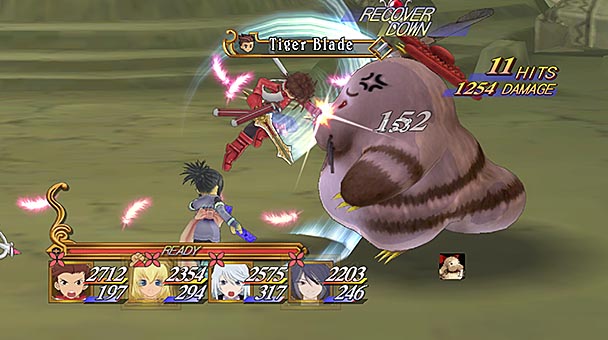
You’ve just been bombarded with tons of information, and all of it points directly towards one, single, inescapable series of conclusions. Like in Dark Souls, you’ve been taught by the game non-verbally, through gameplay, how to fight optimally in a general case.
So, now you’ve figured out that some enemies have a stronger resistance to your stunning attacks, that you can trigger a weakened state in a strong enemy by repeatedly winning exchanges, and that you get one combo to wail on your opponent during this state. The desirability of this state motivates you to play aggressively, as continuing the combo once started is just as important as starting it. The power of this state incentivizes the player towards making elaborate and often spectacular combination attacks that chain-stun the boss for long periods of time, maximizing the amount of damage they can deal. Over time, the player grows more adept at creating and exploiting these situations. Their pool of moves expands, resulting in these combos becoming increasingly more intricate and stylish. However, due to the relatively simple and limited control scheme, they don’t become that much more difficult to execute, and carry a distinct flair based on your own personal move preferences that have been developing over time.
It’s a little simplistic, but it shows what an uncomplicated system can do when properly nurtured and balanced. Combat boils down to dodging, blocking, or anticipating and avoiding enemy moves, then unleashing a flurry of attacks to create combinations similar to that of a fighting game. Really skilled players can create very high hit count combos with the aid of friends or through hot swapping to other allies, and the satisfaction of doing so is palpable. Boss fights feel epic, the system is easy to pick up and tough to really master, and the game offers lots of customization options as you progress. It even offers multiple difficulty modes and replay incentives for those that want to try experiencing the story differently or switching up how combat works. It’s really hard to go wrong here.
Go Wrong Here
Though I gush, Symphonia is by no means perfect. There are certainly a decent number of execution flaws and bugs present, and characters could use a bit more variance in how they fight. I hesitate to delve too deeply into the more surface level issues though, because most of these problems were solved in Tales of Vesperia, another Tales game released several years later. Vesperia expanded on Symphonia‘s fluid combo system, and really developed a unique playstyle for each party member. Mage type characters are brought into the fold too, with their combat systems upgraded and brought to the level of depth that melee characters enjoyed in Symphonia. The number of small quality of life changes added between the two games is too numerous to count, but almost all of them were welcome. This is how sequels should be done from a pure gameplay perspective. Future games experimented with altering how the player accessed skills and worked together with NPC party members, but most Tales players will look back on Symphonia and Vesperia as the strongest titles.
One glaring design flaw though is that of the multiplayer, in so many subtle and unsubtle ways. Multiplayer is essentially an afterthought – just single player with friends who control your NPC allies instead. Symphonia’s camera is never prepared for a second or third player, and never considers the needs of any player but the first. Mages who choose to distance themselves will be left off screen, praying that enemies have not joined them in the unknown, and melee players will often be forced to fight the same target as player one, unable to see their character well if they choose a different target. Additionally, there doesn’t seem to be any rhyme or reason behind enemy target choice while in multiplayer, but that’s just my gut feeling after observation. I mark multiplayer’s flaws as design flaws and not execution ones because it feels like the ramifications of multiplayer were not prepared for at all. If multiplayer is included in a game such as this, it should be something beyond a tacked on sideshow. Though the Gamecube didn’t have a stellar track record with online multiplayer, cooperative local multiplayer would have been enough to be interesting if there was some additional gameplay premise. An alternate mode perhaps, where you could fight an endless set of foes with loaded game data, or have competitive matches with friends, would have been a welcome and fairly simple addition. Having a mode like this would’ve helped to elucidate exactly what made Mages so uninteresting in Symphonia as well.
Final Thoughts
I had a feeling this Analysis would be quite a bit shorter than the first. I was slightly wrong, and I personally think that’s interesting (and possibly bad)! Tales of Symphonia is essentially a layering of simple, straightforward management and customization mechanics on top of a fun but somewhat shallow story-driven combat game. Unlike Dark Souls, where the game itself is making a statement, Symphonia is more of a lighthearted distraction. It isn’t a game that trains you rigorously to think a certain way, or pushes you to overcome some great obstacle, it gently nudges you into a space to experiment instead. Take it at face value, beat up some dudes, and try to get sucked into the story. If that’s your sort of thing, I promise you won’t regret it. Especially if you get the Playstation version with special moves and additional content.

Always looking for more input! Let me know how this analysis was in the comments! There was a lot to cover on this one, and I skipped a lot of minor aspects. Should I focus on the bigger systems, or try to hit everything?
 The Back Burner