Developed by Sega
Release: 2008 (PlayStation 3), 2014 (PC)
The Forgotten Front
Dateline: Twenty-aught-eight. The Third Great Console War is heating up gamers like never before. Old rivalries are becoming bitter grudges, and humanity is being crushed under the weight of sensationalized corporate competition. Titles are being called to action to serve their respective nations in glorious, entertaining, virtual combat once more.
One such title was Valkyria Chronicles, which was called to serve the PlayStation warmachine. As a teenage Xbox 360 owner, I could merely watch from afar as this beautifully styled Roleplaying-Tactical-Turn-Based-Third-Person-Shooter hybrid thing served with quiet distinction for the hated enemy. I had long since forgotten about this game when news of its upcoming Steam re-release surfaced. It experienced an unbelievable revival, nearly doubling its original release sales and topping popularity charts on release day ahead of competing and recently released triple-A titles. I jumped at the chance to play this gem from the past for the first time, and I wasn’t disappointed.
Familiar Heroes
Valkyria Chronicles’ overall concept doesn’t seem that different from a number of games you may be familiar with. You play as the invisible decision-making entity behind a ragtag group of soldiers lead by Welkin, a simple man drawn by forces beyond his control into perilous combat with an invading nation in an alternate universe WWII era conflict. The player guides Welkin through a series of story missions, managing his troops, issuing orders, and learning new information about the conflict. Missions are completed via tactical management of troop movements and special abilities. Outside of combat, weapons and armor are upgraded via research, squad members can be swapped out with reserves, and various other RPG-esque tasks are performed.
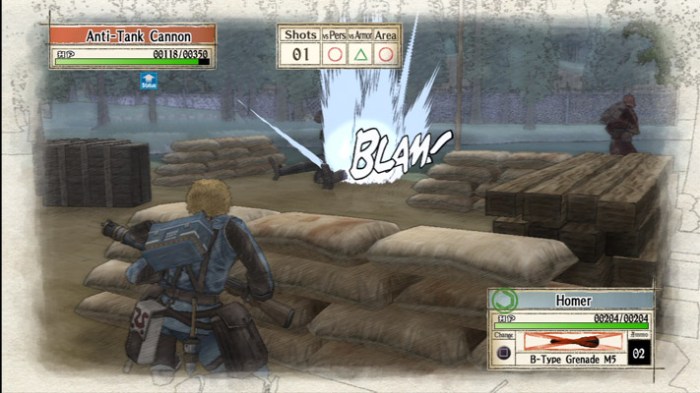
Visually, this is all accomplished through an engine called CANVAS, which renders characters and backgrounds in a hand-drawn manner, and is responsible for Valkyria‘s unique style. This is combined with the game’s use of visual onomatopoeia (a big explosion triggers a “boom!”) and other 2D effects to create the sensation of playing within a comic. The primary story menu is designed in an interesting way as well, with combat scenarios and cutscenes being sections of pages in a book. This makes it easy to put down the game and pick it up again, as you can quickly remember exactly what you were doing and where they story is by visually identifying certain headlines and images. Despite all of the visual uniqueness, the combat mechanics are actually the most memorable part of Valkyria.
Turn-Based Real-Time and You
So I’ve mentioned twice now that Valkyria has an interesting hybrid of combat systems, like Fire Emblem smashed together with Worms. Now I’ll finally explain what that means and why it’s cool. After mission preparation is done, combat rounds begin, starting with the player’s turn. On a given player’s turn, their units, major map features, and known enemy locations are displayed on a tactical map, like so.
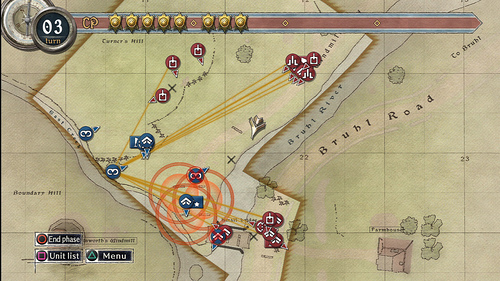
Blue circles represent allied forces, while Red ones are enemy controlled. Each symbol represents a different soldier class, each with a different specialization. The various lines drawn on the map are indicators of a variety of things, such as line of sight, imminent danger zones, and combat zone borders. At the top are your Command Points, or CP, which are spent to issue orders to individual troops, or to issue sweeping orders that provide bonuses to your entire squad. Once you’ve used this map and associated menus to get a feel for what you want to do and who you want to do it with, you select a unit to issue orders to individually, spending a CP and transporting you to a third-person view of that unit.
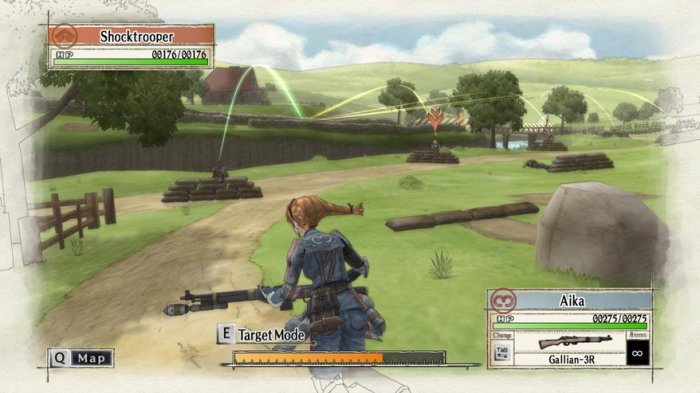
This third-person perspective is where you execute your plans. Spending a CP on a unit allows you to move that unit freely until it is out of action points, represented by that orange bar at the bottom of the screen. When you’ve found the right position, you can then fire one weapon or use one item from that unit’s inventory. That unit’s move is over when you fire your weapon, decide you’re positioned where you want to be, or are reduced to 0 hp by enemy overwatch fire or clumsily inflicted collateral damage. Choosing to fire your weapon calls up a fairly standard targeting reticle, and you can fire one salvo of your chosen weapon’s ammunition.
Strategy games contribute the process of deciding which unit is going to deal with which enemy, creating flanking maneuvers, and working as a squad commander, and third-person shooter mechanics are used to execute those orders. Though more simplistic than a game of either pure genre, Valkyria’s fusion of the two is snappy and easy to understand. In spite of its new approach to gameplay, a lot of its problems are actually pretty routine in the gaming world.
Sniper Tanks and Other Improbabilities
Valkyria’s most glaring problem is its enemy AI, and its method of dealing with this weakness. It’s difficult to gauge exactly where the enemy AI struggles the most, as much of the game’s enemy movements take place behind the fog of war, but Valkryia‘s imperfect AI is also supported by a band-aid in the form of blatant double standards. Propping up a less than perfect AI system by making it have unfair advantages is an industry standard practice, especially in games with reflex-testing components. It’s a comparatively effortless way to retain challenge in an otherwise easy game, and doesn’t require altering or rebalancing existing systems. It can be done well too, in such a way that the player does not notice or does not feel like the system itself is unfair. Valkyria does not accomplish this.
Valkyria‘s solution to AI that often decides to run back and forth during turns, take shots that cannot hit, and generally run into certain death, is to overpower their combat abilities. Specifically, Valkyria overpowers enemy accuracy, making it incredibly high in some situations. Accuracy is extremely important for Snipers and anyone using explosives, as it controls if and by how much a shot deviates from its desired hit location. Snipers like to take shots at extreme distances, and explosive users, like Tanks and Lancers, need to have their payloads delivered to specific zones or risk damaging their own squads and interests. Without solid accuracy, these classes become useless and risky. However, these classes being able to hit consistently amounts to the safest, strongest sources of damage imaginable due to their long ranges and high damage.

Enemy controlled Tank units routinely nail unbelievable shots across entire map lengths, decimating even moderately exposed allies with their ungodly accuracy. Though this problem is manageable, as positioning your squad to be completely hidden from any enemy counterattack is always the best option during missions, there are inevitably situations where Tanks have the opportunity to take a shot at your vicinity. Player blunders are disproportionately devastating due to these Sniper Tanks, and certain missions become frustrating headaches due to safe placement of enemy Tank units.
Enemy Sniper and Lancer units are also incredibly frustrating to deal with because of accuracy issues. The consistency and difficulty of shots pulled off by opposition Snipers is rage inducing, especially considering their early introduction into the enemy roster. Lancers are similarly infuriating, as this class is meant to have an extreme lack of long range capabilities due to having an extremely large potential for shot deviation. With enough accuracy, however, this weakness is completely negated.
This would be all well and good if it weren’t that your own attempts to use these classes were radically different. While Tanks are extremely strong in player hands, Lancers are nigh useless by comparison, crippled by lack of mobility and niche utility. Snipers are also notoriously weak in mobility, but additionally lack the accuracy to make the long distance shots expected of their namesake without significant upgrades. Though Lancers also need significant changes to be brought up to the level of other classes, such as an action point boost or a secondary weapon, making enemy units less statistically unbalanced would be an easy way to make the game more enjoyable.
Very Few Good Men
While the gameplay issues are important, they’re mostly reducible through balancing. Perhaps there were simply too few iterations on standard gameplay to catch them, or perhaps they were treated as acceptable. I can understand that. In my mind, the truly unreasonable issue is that of the mission success rating. Though it is certainly an even simpler issue to address than unbalanced gameplay and overly unfair AI, and barely impacts gameplay in any direct way, it represents a fundamental misunderstanding of what kind of game Valkyria Chronicles is trying to be in my mind. Consider a completed mission in Valkyria, with the following screen afterwards.
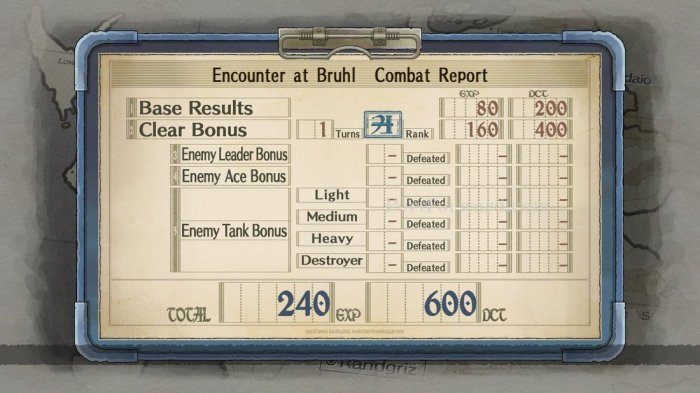
As you can see, there are EXP and DCT rewards for completing missions, the two forms of currency in the game. Each reward upgrades different things, but both are important to improving your squad. If you’ll notice, this particular mission was cleared with an A rank. Ranks determine how much of each reward you receive, which in turn determines how much you can upgrade your squad. After running quite a few missions, my ratings started to become consistently lower than A, and I wasn’t quite sure why. I spent a lot of time re-doing missions I wasn’t successful on, as is a fairly standard practice in games with permanent character deaths, but my high hit rates and perfect character retention eventually was earning me B and C ratings. I took a trip to the internet, and in doing so discovered something unfortunate – mission ratings are based almost entirely on the number of turns taken, and the turn requirement becomes very strict in later missions.
This doesn’t seem like a real problem at first glance. Increasing the rewards for faster gameplay makes sense. Fewer moves required to win? You’re definitely mastering the system, and thus you should be rewarded. Conceptually that’s fine, but the reality is different. Even if the player is becoming better at preserving their units, creating flank situations, and managing their troops, their priorities are completely realigned because of that C rating they’ll inevitably receive. All other metrics of success are essentially ignored, making it hard for players to gain a sense of mastery. On missions without specific turn ends, especially ones with zone capture objectives, sneaking your way in with an unrealistic, rambo-esque strategy becomes the best policy for achieving the highest rating.
Though this could be a fun game in itself, the existence of this alternate metagame represents a departure from what the game is clearly intended to be. This may just be my opinion, but reinforcing and rewarding a specific strategy sends the message that this strategy is ideal the game strives to coax out of the player. Is risky, fast gameplay involving a small squad size, sneaky play, and underhanded tactics really the ideal? Other than the mission rating system, everything else encourages classic warfare, larger army sizes, and balanced squad compositions. Reworking the mission rating system to be less strict, and have it be more based on smart decision making, would make the game’s objective feel more coherent. Relaxing turn restrictions, adding in downed and lost ally penalties, and creating some objective way of measuring combat effectiveness, such as shot accuracy, would help to focus the game more.
Final Thoughts
I promise I’ll stay away from JRPGs for awhile, but I had to get these last two off my chest. Valkyria‘s success on the Steam platform, despite being a nearly unchanged rerelease of a game from the previous console generation, is an important indicator of, well, probably a lot of things. Strategy games aren’t dead, weird JRPGs aren’t dead, and if it’s good it’ll sell, whatever it happens to be. Valkyria is good, and it sold like hotcakes as a result. This first game in what became a series was a risk, without the guarantee of a franchise, without a massive, multiplatform, multimedia effort guiding it. Cool stuff like Valkyria only exists in a world where people can risk mashing genres and rocking the boat with a new IP.

Another one bites the dust. A lot faster turnaround this time too! Expect this to be the trend from now on, o nameless reader. Any follow up questions, suggestions, comments, or concerns? Drop me a line here or through some other media outlet. Especially if it has to do with games, I love talking about games.
 The Back Burner